Category Archives: algorithms
When it comes to digital methods, one of the basic conundrums one encounters is the ambivalence between platform and practice. To phrase it in basic terms: are outcomes genuine human practice or simply artifacts of the platform’s affordances? There are different ways to approach this problem conceptually and I would go as far as saying that it is a false problem, since I do not think that there is something like unmediated human practice in the first place. The fact remains, however, that we may want to focus on one or the other for various reasons. My own interest lie squarely in understanding the technical dimension and this post introduces an approach to studying the algorithms at work in social media platforms with the help of digital methods.
While a number of scholars have recently been engaged in attempts to reverse engineer relevant algorithms, the objects I am interested in are clearly too complex and dynamic to reproduce the decision mechanisms involved – which, in any case, are probably in constant movement due to machine learning components being part of the larger procedure. My goal is actually more basic and the approach I want to present is largely descriptive in the sense that it does little more than propose a way to talk about the outcomes of algorithmic work, in this case of ranking mechanisms. By “talk about”, I first mean graphically and quantitatively, but the goal, in fact, is quite qualitative. While I have real sympathies for the desire to describe artifacts considered to be the apogee of exactness in exact terms, I think that we need to explore other directions as well. In any case, we constantly examine and analyze phenomena in ways that do not require formal descriptions. We can study the NY Times’ editorial decisions – which involve a lot of ranking and appreciation of value – in ways that do not include building a formal decision model and still make interesting observations. Maybe it is time to see how methods for describing social phenomena can be used to describe formal mechanisms and not the other way round. What I have in mind does not go very far in this direction, but it embraces description as its methodology.
To make this idea more plastic, I take YouTube (YT) as my example and focus on YT’s search ranking. When looking for the keyword [syria], for example, YT returns an ordered list of videos. How can we talk about the produced rankings, here? One way would be to look into the factors YT itself communicates as relevant or turn to SEO blogs to gather attempts to identify the central variables. This is certainly interesting, but we could also just look at the results themselves. Using the YouTube Data Tools (YTDT), I have been collecting daily rankings for a number of keywords over the last months, [syria] being one of them. This file contains the data for five days. The rows are videos ordered by result rank and there is also a viewcount for each video. The file looks like this:
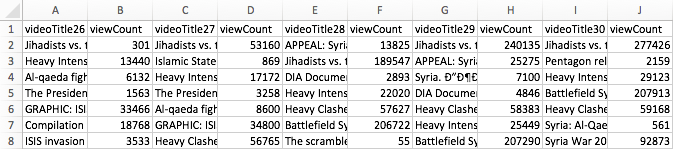
A very basic way to start making sense of these results is to visualize them. To help with this, I built a small tool, RankFlow, which is explicitly designed for analyzing rankings over time. Here is a screenshot of a visualization of the data (click for larger image):

Every column is a day of videos and each column is ordered by result rank. The height of each block encodes the viewcount variable as logarithm (to compress the vast differences in viewcount) while colors (from blue to red) indicate the unprocessed viewcount. The video with the highest viewcount actually only appears at rank 15 on the fifth day. What can we learn from such a basic visualization? First, absolute viewcount is obviously not the main ranking criterion. Second, rankings change quite a lot; between the second and the third day, for example, seven videos fall out of the top 15 and the video that comes in first on day three is again gone on day five. Third, there are a number of videos in the top ranks that have surprisingly low viewcounts. What I take from this case – and others I have looked at – is that YT probably uses a predictive ranking model that calculates something like a “chance to find an audience” metric (e.g. based on channels’ previous videos), places the video in the rankings, and – if it does not catch on – removes it again quite quickly (the top video on the first day is good example for a video that does catch on). This is in stark contrast to the “authoritative” rankings on Google Search that change much less frequently and tend towards something like a stable consensus. On YT, the ranking mechanism seems to “care” much more about quick turnover, newness, and serendipity. Looking at a simple RankFlow can give us a pretty good idea what is happening with a specific query and looking at a number of them can lead us to a more general assessment about output dynamics.
A second approach to describing ranking follows a direction that uses an algorithm to talk about another algorithm’s output. The problem with the above visualization is that it quickly gets very complicated to read and summarize when we start adding columns. But information scientists have been working on ways to produce quantitative measures to describe changes in rankings. On the bottom of the above visualization, you can see a number that tries to measure the changes between each two day pairs. There are many such measures available, but the one I found most intriguing came from a 2010 paper by William Webber, Alistair Moffat, and Justin Zobel. This was the one metric I found that would a) work with ranked lists where elements are not necessarily the same for each list (i.e. a video present on one day is no longer there on the next day), b) take into account changes in rank, not just presence or absence of an element, and c) attribute more value to changes at the top of the list than changes happening at the bottom. Rank-Biased Overlap (and its metrical form, Rank-Biased Distance) does just that. The RBD value between two days thus interprets changes in rank in a particular way and it condenses its interpretation into a single value. The higher the value, the more change. This is, of course, a reductionist gesture, but if we understand how the metric reduces, it can be extremely helpful to make sense of the “changiness” of rankings in a context where we have a lot of data. The algorithm (equation 32 in the paper, the “calc_rbo” function in my implementation) is not simple, but if you take some time to compare the visualization to the RBD values, you can get a basic feel for how it reacts to changes in rankings. This opens the door to more “macro” appreciations of changes in ranking and, interestingly, to comparison between platforms. A high average RBD value would indicate a tendency to fluctuate, a low value a preference for stability.
Both of these examples do not allow us to reverse engineer the actual algorithm(s) in question, but we need to get comfortable with the idea that this is not going to be an option in most cases anyways. Systematic description, however, allows us to still say something about the structure and dynamics of outputs and gives us an idea of the character or temperament of a ranking mechanism, for example. This post is just a starting point that I hope to turn into something more substantial in the future, but I hope it shows how relatively simple techniques can be employed to make potentially interesting findings.
One of the reasons I started to develop the netvizz application, was to get better insights into how Facebook envisions exchange of data and functionality with third party developers. From the beginning, I was quite amazed how much data a third-party app could actually get from the platform – not only about the users that actually install an app, but also about their friends and the groups they are members of. I hope to provide a systematic account of what I’ve learned at some point in the future. But today, I want to discuss a particular element in some more detail, the “read_stream” permission.
To introduce the matter, a couple of points concerning the Facebook APIs as such: every application written by a third-party developer requires a logged in user and this user defines the “scope” of data access the running instance of the application can get – remember that applications are generally used by many users, so the data gleaned from individual scopes can be combined. Applications have to explicitly ask for permission to access certain items and Facebook provides extensive documentation on the permission system, the profile properties, and a set of extended permissions. Users are asked to grant these permissions when they first start an app. This is the permission dialogue for netvizz:

Netvizz currently asks for the following permissions: user_status, user_groups, friends_likes, user_likes, and read_stream. When installing, you cannot refuse individual elements that are not considered “extended permissions”, only decide to not use the app at all. The user_status is actually superfluous and will be removed in the next iteration. The user_groups permission is needed to access group data and both _likes permissions are used for netvizz’ like network functionality.
Now, working on a couple of new features over the last months, I started to get more interested in posts because they have probably become the closest thing to a “carrier of publicness” on the Facebook platform. I was quite amazed how easy it was to extract large numbers of users and (some) of their data from pages – both likes and comments users make on post on or by pages are in principle up for grabs. When doing some housekeeping recently, I noticed that some of the “engagement” metrics netvizz had provided for users’ friends in earlier versions were either broken or outdated and I decided to simply count the number of likes and posts friends make to replace the older metrics. I expected to only be able to read likes – through the friends_likes permission – and public posts. This was indeed true: in the beginning, all I got were public posts. Because I could get much more data through the Graph API Explorer, a developer sandbox that asks for all permissions by default (which can be changed, a great way to explore the permission structure), I discovered the read_stream permission.
The read_stream permission is presented by Facebook in the following way: “Provides access to all the posts in the user’s News Feed and enables your application to perform searches against the user’s News Feed.” It is a so-called “extended permission”, the developer doc noting that “Extended Permissions give access to more sensitive info and the ability to publish and delete data”. And, indeed, when asking for read_stream in netvizz, I suddenly got access to many more posts made by my friends, mostly going from “none” to “a lot”. From what I could gather after some random testing was that I basically got access to all of the activities from my friends that would show up in my newsfeed, without the “top stories” filter. Because many things have the status of “post”, I could get a rather detailed (and timestamped) account of what my friends are doing on the platform. You can check out your own “posts” feed by following this link into the Graph API Explorer. Because comments and likes by users who you are not friends with on posts by somebody you are friends with also show up in your news feed, the read_stream permission allows to capture their activity as well. Facebook seems to be aware of this: because read_stream is an extended permission it gets its own permission dialogue and can actually be skipped:
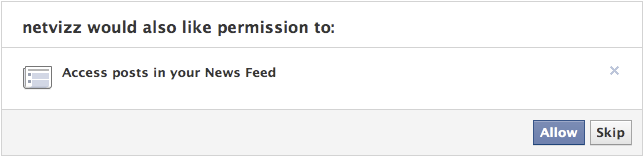
This is a good thing, but the wording seems a bit sparse: “Posts in your newsfeed” actually translates to “a minute account of your friends’ activities”. Granted, buried in the privacy settings is an option that allows us to modify more generally what information we share with the apps other people use, and these are the default settings:
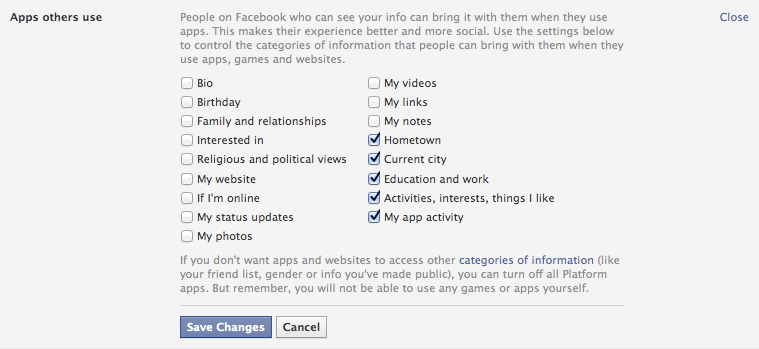
It’s the “Activities, interests, things I like” option that allows the read_stream permission to work its magic. The people I am friends with on the platform are generally a rather privacy conscious bunch, but I could get the posts from most of them.
This is not a privacy scandal of any sort, measures are in place, but one can still make a couple of points:
- Apps as means for data capture are clearly not discussed enough. For serious data collection, however, going through the API is clearly the way to go and we need to pay more attention to this.
- Again and again: defaults matter. As seen above, the data available to apps used by friends is quite extensive with default settings.
- Again and again: language matters. The read_stream permission dialogue is certainly not explicit enough. Also: why is “app privacy” not in the privacy tab here?
- When we log into a third party site with our Facebook login, we are basically running an app. May be worth pondering what data we are shipping over.
Exploring APIs as important actors in the privacy debate and beyond is crucial. It’s often complicated work, though, and I hope that the developer community can help with that work a bit. It would be highly useful, I think.
The second issue of computational culture is out and I am really looking forward to plunging into it once my teaching schedule leaves me a little bit more time. I am very happy that my paper made it in. As I am currently preparing a lecture on visual analysis for a class, I’ve been using the text for a bit of fun.
James A. Danowski‘s co-word tool wordij is unfortunately no longer online (why?), but it’s a really interesting and powerful piece of software and I used it here to create an alternative view of the paper (click for bigger image) with the help of gephi:

Many Eyes is still has a few tricks up its sleeve and this word tree visualization is really quite a strong tool for exploring the use and context of select words in a text:
These really work quite well on this particular paper, but I hope to spend more time with text analysis over the next months – working on historical papers from computer and information science – to see how well these and other tools hold up in a truly exploratory context.
Last week Google introduced its new, ontology driven infobox and I have just been included into the roll-out. The whole knowledge modelling thing is quite a slippery slope though. Just compare these two boxes:


I don’t know about you, but I guess that Hitler l’auteur is perhaps not the most fitting template.
Yesterday, Google introduced a new feature, which represents a substantial extension to how their search engine presents information and marks a significant departure from some of the principles that have underpinned their conceptual and technological approach since 1998. The “knowledge graph” basically adds a layer to the search engine that is based on formal knowledge modelling rather than word statistics (relevance measures) and link analysis (authority measures). As the title of the post on Google’s search blog aptly points out, the new features work by searching “things not strings”, because what they call the knowledge graph is simply a – very large – ontology, a formal description of objects in the world. Unfortunately, the roll-out is progressive and I have not yet been able to access the new features, but the descriptions, pictures, and video paint a rather clear picture of what product manager Johanna Wright calls the move “from an information engine to a knowledge engine”. In terms of the DIKW model (Data-Information-Knowledge-Wisdom), the new feature proposes to move up a layer by adding a box of factual information on a recognized object (the examples Google uses are the Taj Mahal, Marie Curie, Matt Groening, etc.) next to the search results. From the presentation, we can gather that the 500 million objects already referenced will include a large variety of things, such as movies, events, organizations, ideas, and so on.
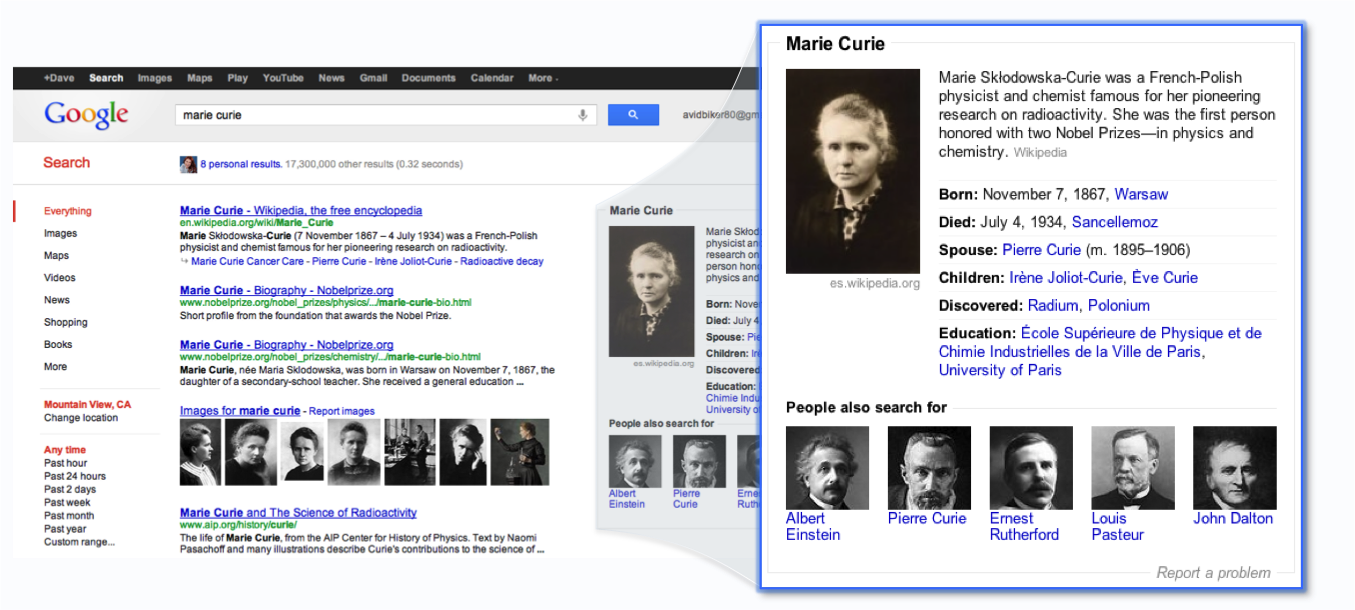
This is really a very significant extension to the current logic and although we’ll need more time to try things out and get a better understanding of what this actually means, there are a couple of things that we can already single out:
- On a feature level, the fact box brings Google closer to “knowledge engines” such as Wolfram Alpha and as we learn from the explanatory video, this explicitly includes semantic or computational queries, such as “how many women won the Nobel Prize?” type of questions.
- If we consider Wikipedia to be a similar “description layer”, the fact box can also be seen as a competitor to everybody’s favorite encyclopedia, which is a further step into the direction of bringing information directly to the surface of the results page instead of simply referring to a location. This means that users do not have to leave the Google garden to find a quick answer. It will be interesting to see whether this will actually show up in Wikipedia traffic stats.
- The introduction of an ontology layer is a significant departure from the largely statistical and graph theoretical methods favored by Google in the past. While features based on knowledge modelling have proliferated around the margins (e.g. in Google Maps and Local Search), the company is now bringing them to the center stage. From what I understand, the selection of “facts” to display will be largely driven by user statistics but the facts themselves come from places like Freebase, which Google bought in 2010. While large scale ontologies were prohibitive in the past, a combination of the availability of crowd-sourced databases (Wikipedia, etc.), the open data movement, better knowledge extraction mechanisms, and simply the resources to hire people to do manual repairs has apparently made them a viable option for a company of Google’s size.
- Competing with the dominant search engine has just become a lot harder (again). If users like the new feature, the threshold for market entry moves up because this is not a trivial technical gimmick that can be easily replicated.
- The knowledge graph will most certainly spread out into many other services (it’s already implemented in the new Google Docs research bar), further boosting the company’s economies of scale and enhancing cross-navigation between the different services.
- If the fact box – and the features that may follow – becomes a pervasive and popular feature, Google’s participation in making information and knowledge accessible, in defining its shape, scope, and relevance, will be further extended. This is a reason to worry a bit more, not because the Google tools as such are a danger, but simply because of the levels of institutional and economic concentration the Internet has enabled. The company has become what Michel Callon calls an “obligatory passage point” in our relation to the Web and beyond; the knowledge graph has the potential to exacerbate the situation even further.
This is a development that looks like another element in the war for dominance on the Web that is currently fought at a frenetic pace. Since the introduction of actions into Facebook’s social graph, it has become clear that approaches based on ontologies and concept modelling will play an increasing role in this. In a world mediated by screens, the technological control of meaning – the one true metamedium – is the new battleground. I guess that this is not what Berners-Lee had in mind for the Semantic Web…
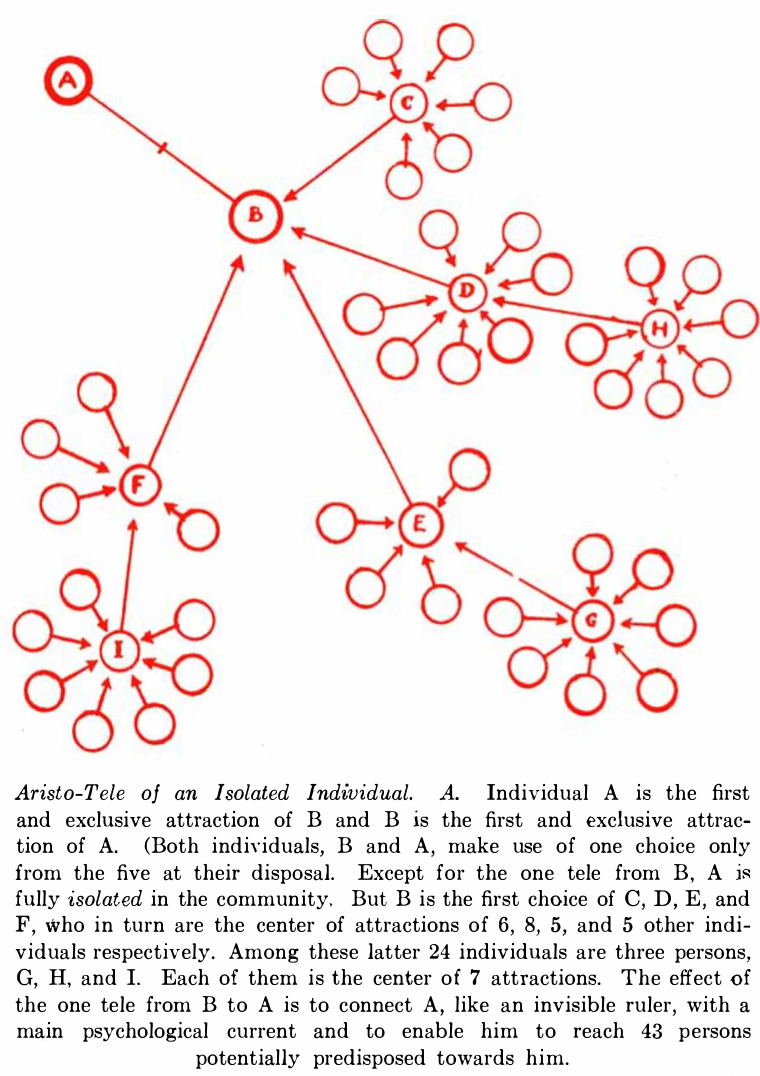
one of Moreno's famous sociograms
I am currently writing a paper to submit to the new and very exciting journal computational culture on the use of graph theory to produce “evaluative metrics” in contexts like Web search or social networking. One of my core arguments is going to be that the network as descriptive (mathematical) model has never stood in opposition to the notion of hierarchy but should rather be seen as a conceptual tool that was used in different fields (e.g. sociometry, psychometry, citation analysis, etc.) over the 20th century to investigate structure and, in particular, to both investigate and establish hierarchy. This finally gave me an excuse to dive into Jacob L. Moreno’s opus magnum Who Shall Survive? from 1934, which not only founded sociometry but also laid the ground work for social network analysis. This is one of the strangest books I have ever read, not only because the edition from 1978 reveals the author as a deeply Nietzschean character (“Actually, I have written two bibles, an old testament and a new testament.“), but also because the sociogenic therapy Moreno proposes as an approach to the “German-Jewish conflict” puts the whole text in a deeply saddening light. But these aspects only deepen the impression that this is a fascinating book, really one of its kind.
Interestingly, Moreno also discovered what we would now call “power-law dynamics in social networks”. One of the applications of his “sociometric test” – basically a “who do you like” type of questionnaire – in a small American town named Hudson came to the following result:
After the first phase of the sociometric test was given the analysis of the choices revealed that among a population of 435 persons,23 204, or 46.5%, remained unchosen after the 1st choice; 139, or 30%, after the 2d choice; 87, or 20%, after the 3rd choice; 74, or 17%, after the 4th choice; and 66, or 15%, after the 5th choice. (Moreno 1934, p. 249)
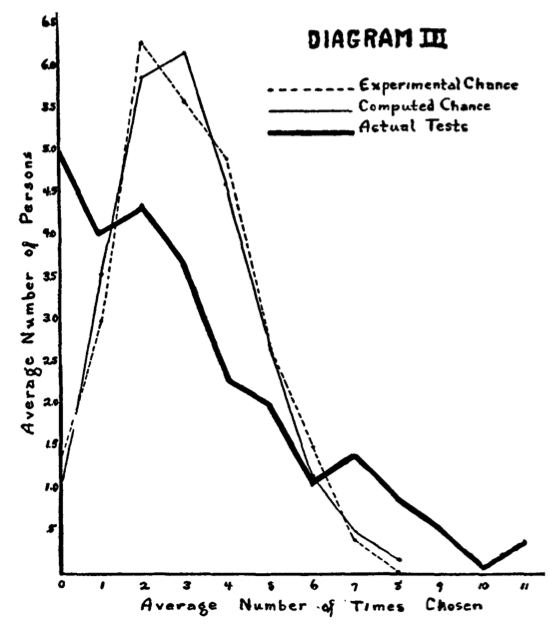
Moreno's comparison of distributions
This means that 15% of the population was not mentioned when the interviewees were asked which five people in the community they liked best. While this does not make for a particularly skewed distribution, Moreno transposes the result on the population of New York city and adds a quite tantalizing interpretation:
There is no question but that this phenomenon repeats itself throughout the nation, however widely the number of unchosen may vary from 1st to 5th or more choices due to the incalculable influence of sexual, racial, and other psychological currents. For New York, with a population of 7,000,000, the above percentages would be after the 1st choice, 3,200,000 individuals unchosen; after the 2nd choice, 2,100,000 unchosen; after the 3rd choice, 1,400,000 unchosen; after the 4th choice, 1,200,000 unchosen; and after the 5th choice, 1,050,000 unchosen. These calculations suggest that mankind is divided not only into races and nations, religions and states, but into socionomic divisions. There is produced a socionomic hierarchy due to the differences in attraction of particular individuals and groups for other particular individuals and groups. (Moreno 1934, p. 250f)
By looking into the history of the field, I hope to show that the observation of uneven distributions of connectivity in real-world networks, e.g. the work by Hindman and others concerning the Web, are certainly not a discovery of the “new science of networks” of recent years but a virtual constant in mathematical approaches to networks: whenever somebody starts counting, the result is an ordered list, normally with a considerable difference in value between the first and the last element. When it comes to applications of sociometry to sociology or anthropology, the question of leadership, status, influence, etc. is permanently in the forefront, especially from the 1950s onward when matrix algebra starts to allow for quick calculations of different forms of centrality. Contrary to popular myth, when Page and Brin came up with PageRank, they had a very wide variety of inspirational sources to draw from. Networks and ranking had been an old couple for quite a while already.
In 1953, Leo Katz, psychologist of the measuring kind, wrote the following:
The purpose of this paper is to suggest a new method of computing status, taking into account not only the number of direct “votes” received by each individual but, also, the status of each individual who chooses the first, the status of each who chooses these in turn, etc. Thus, the proposed new index allows for who chooses as well as how many choose.
The paper this is taken from is one of the references in Larry Page’s PageRank patent…
The emerging field of software studies (and micro-annexes like “code studies”) shows a remarkable interest in code obfuscation (e.g. here, here, and here), a fun practice for creative programmers that plays on the fact that source code is text and can therefore be endlessly transformed (there are also more serious uses for obfuscation, generally in situations where source code is visible by design, e.g. JavaScript on the Web). While the practice of making a program’s source code unreadable without breaking functionality is indeed a way of approaching software from a potentially revelatory angle, I am somewhat astounded by how much attention humanities scholars pay to an exercise that is diametrically opposed to what 99% of all programmers spend considerable blood, sweat, and tears on every day, namely to make their code readable.
Code obfuscation as creative and playful practice for expert programmers speaks to the humanities’ interest in the original, the artistic, the deviant, and the critical but there is a real danger of losing connection with the mundane practice of writing software, where considerable energy is spent on writing code in a way that other people can easily understand it and, perhaps even more importantly, that a programmer can understand it quickly herself when coming back to a script or module weeks or months after it was written.
As most programmers will attest, the considerable difficulty of programming lies not so much in the “programming” part but in the managing of large amounts of stuff: complex architectures that span over many modules, huge APIs and libraries that provide highly specialized functionality, programming languages with always growing numbers of comfort functions (just look at how many array functions there are now in PHP), pages and pages of (sometimes badly written) documentation, different versions of basically everything, and – of course – the large amounts of code we ourselves and the people we work with have written, not so rarely under considerable time constraints, which leads of course to less than stellar code. The logistical dimension of programming is considerable.
SVN systems, powerful IDE’s (for somebody like me who only programs a couple of hours per week, autocomplete and integrated documentation are simply a godsend), and better development methodology obviously make the task of negotiating this massive environment a lot more bearable, but these tools are not eliminating the need to read code all the time to understand what’s going on. That’s why we try to make it readable as we write it and good refactoring (going over one’s code after the functionality is implemented) treats readability as a priority. But still, every programmer I know has, at one point in time, decided to write a library or a program herself simply because she didn’t want to experience the excruciating pain of reading somebody else’s poorly written code. This is how bad things can get.
Computer Science literature (like Steve McConnell’s classic Code Complete) and the Web are full of guidelines on how to write readable code and recommendations are intensely discussed and can be extremely detailed. I would like to argue here that one can learn as much – or more – about software by looking at strategies for readability than by looking at obfuscation. Some things are rather obvious, like choosing good names for modules, classes, functions, and variables; or like code indentation, which some programming languages have even made a requirement. Good commenting seems to be rather evident as well but there are many different schools of thought on that and automated comment generation in certain programming editors has not lead to real standardization. In general, while there is certainly wide agreement on the need for readability, the persistence of differences in style makes it clear that this is largely a question of convention and therefore depends on normative agreement rather than on simply finding the “best” technique.
But what I find most interesting about the question of readability is that beyond the cited elements lurk even more difficult questions that concern the borders between readability and architecture and between readability and complexity. Ed Lippert for example writes: “Don’t write ‘clever’ code; the maintenance programmers don’t have time to figure out your cleverness when it turns out to be broken.” This points to some of the basic tensions in modern software design and engineering: while programmers learn to value elegance, efficiency, and compact code, the requirements of large teams with a high degree of division of labor and the general speed-up of hardware can make readability a higher priority than execution speed or compactness. This can also mean to not use certain obscure functions or syntactical conventions. Consider these two examples in JavaScript:
variable1 = (variable2 == 10) ? 20 : false;

and

if(variable2 == 10) {
  variable1 = 20;
} else {
  variable1 = false;
}
These two elements are functionally equivalent; the first one however is much shorter and, especially for less experienced programmers, more difficult to read and understand.
Another question concerns when and how to divide code into functions, objects, modules, etc. Dustin Boswell and and Trevor Foucher’s Art of Readable Code for example recommends to “extract unrelated subproblems” by moving the code into a subroutine. While this may be straightforward in many cases, what the “reader” needs to know to understand the code can vary a lot from one case to another. Creating subroutines can certainly help with readability (and make code more easily reusable), but it a) means that the reader has to track down the subroutines and b) may make the code more complex simply because the subroutine may take into account different use cases that have to be distinguished. While redundancy is often considered a crime, it can have benefits when it comes to readability.
The subject of readability can be (and is) discussed infinitely but what is significant from a software studies’ perspective is that the problem points to the incursion of a social and economic context into the practice of programming. Not only do we ask “what is my code supposed to do?”, but also “who is going to read my code?”, “will other people work with my code?”, “is this something I will reuse?”, “how important is execution speed?”, and so on. While studying obfuscation points to the duality of computer code as text and machine, the readability question reveals it as caught up in various contexts that have to be negotiated in the practice of programming itself. That code is executable is the technical condition for software. That code is readable is not a requirement on the same level; but it has become a major aspect to a program’s capacity to become part of an increasingly structured professional practice.
In the middle of December, a French appeals court published its verdict in a case concerning Google’s instant/autocomplete/suggest feature and the company was fined $65K. After the holidays, a couple of publications (e.g. searchengineland and Ars Technica) picked up the story and as in every case where French legislation diverts from US sensibilities the comment sections erupted with chauvinistic righteousness. What was the case about? Here is the full text of a notice by the Courthouse News Service:
A French court fined Google $65,000 because the search engine’s autocomplete function prompts the French word for crook when users type the name of a certain company. Lyonnaise de Garantie, an insurance company, said staffers at Google should have monitored linked words better. Google had argued that it was not liable since the word, added under Google Suggest, was the result of an automatic algorithm and did not come from human thought. A Paris court ruled against Google, however, pointing out that the search engine ignored requests to remove the offending word – “escroc,” which means crook in French. In addition to the fine, Google must also remove the term from searches associated with Lyonnaise de Garantie.
Unfortunately, this is basically all the information that circulated in English. But it’s always interesting to have a closer look at how lawmakers and judges look at information-systems-as-media question and so I went to have a look at the text of the actual verdict.
There are a couple of points that are really quite remarkable here, and make the case much more interesting than it appears. Google’s arguments basically made three arguments:
- We are an American company and therefore… (I will not go into the questions that are not specific to Web search.)
- The suggest feature is purely “informatic” and does not represent an “intellectual act”, a “value judgement” or an “opinion”. (This is the common argument, nothing new here.)
- The “average internet user” knows that search suggestions are not content. In fact, users do not make any interpretations independently from search results. There is “no confusion in their minds” about the difference. (Finally, things are getting more interesting!)
The judge however did not see things this way and made a series of quite remarkable observations:
- If the process is fully automated, how does Google remove “offensive” and “vulgar” terms from the suggestion lists? Obviously, intervention is possible and regularly applied, even for content – such as vulgarity – that is not illegal. So why not in this case?
- While it would certainly be difficult to find all cases where individuals or companies are put in a bad light in a suggest list, Google was perfectly aware in this case, because the company in question had contacted them repeatedly.
- While the procedure may be automatic, the phrase “Lyonnaise de Garantie escroc” is a human judgement and its circulation on the net is made possible by the machinery. Using algorithms is just another way of “organizing and presenting human thought”.
- The phase appears already at the moment when one types “Lyonnaise de G” and this “suddenness” has the effect of “imposing the expression” on the user.
- When looking at the results for the query, they do not explain why the term “escroc” is attributed to the company, i.e. the content does not signal any facts that would justify the term.
Now these are some interesting arguments and while I am not qualified to comment on the validity of the judgement, there is a stark contrast between Google’s and the judge’s framing of the question. While Google makes an ontological argument (“an algorithm cannot have an opinion”), the judge pushes that argument into the background and bases the verdict on the question “can Google be bothered to remove a text that is injurious?”. The answer is “yes”, because a) intervention is obviously possible and b) they were made aware by the plaintiff. It also treats the “instant” feature as living up to its former name: “suggest”.
 While regulation of “indecency” is much less pronounced in Europe than in the US, libel laws are of course much stricter, but I do not want to comment on that. What I find thoroughly fascinating about this case is that legal professionals are forced to form opinions about questions as ambiguous as algorithmic agency. By choosing to judge outcomes rather than methodology, the judge in this case (and the judges that treated it in the first instance) have created a precedent that may affect the use of statistical and other techniques that often produce unforeseeable effects. On the other hand side, the verdict is largely based on the fact the the plaintiffs requests for removal were ignored. Google is by no means forced to police suggest features in the future.
Automated information systems order information very differently from manually compiled catalogs or category systems. They produce different forms of “intelligence” and it is difficult to think about their directness in terms of opinion or partisanship. What just happened in this case however is that, at least on a legal level, the gap between the two elements was closed a little bit. The judge did not require Google to put the algorithm on a leash but told them to pick up its mess.
German publisher Heise Verlag is an international curiosity. It publishes a small number of highly influential computer-related magazines that give a voice to a tech ethos that is at the same time extremely competent in the subject matter (I’ve been a steady subscriber to c’t magazin for over 15 years now, and I am still baffled sometimes just how good it is) and very much aware of the social and political implications of computing (their online magazine Telepolis testifies to that).
Data protection and privacy are long-standing concerns of the heise editors and true to a spirit of society-oriented design, they have introduced a concept as well as a technical implementation of a two-step “like” button. Such buttons, by Facebook or other companies, have of course become a major vector of user-tracking on the Web. By using an iframe, every button loads some code from Facebook’s server and sends the referring url (e.g. http://nytimes.com/articlename/blabla) as an information. The iframe being hosted on the facebook.com domain, cross-site privacy protections can be circumvented, the url information connected to an identifier cookie and, consequently, to a user account. Plugins like the Priv3 project block these mechanisms but a) users have to have a heightened level of awareness to even consider installing something like this and b) the plugin interferes with convenient functions like Google search preferences.
 Heise’s suggestion, which they already implemented on their own sites, is simple: websites can download a small bit of code that implements a two-step procedure: the “like” button is greyed out after the page first loads and there is no tracking happening. A first click on the button loads the “real” Facebook code, and the second click provides the usual functionality. The solution is very simple to implement and really a very minor inconvenience. Independently from the debate whether “like” buttons and such add any real value to the Web, this example shows that “social” features like these can be designed in a way that does not necessarily lead to pervasive user tracking.
The echo to this initiative has been very strong (check the Slashdot discussion here), especially in Germany, where privacy (or rather Datenschutz, a concept less centered on the individual but rather on the role of data in society) is an intensely debated issue, due to obvious historical reasons. Facebook apparently threatened to blacklist heise.de at a point, but has since then backpedaled. After all, c’t magazin prints around 600.000 issues of every number and is extremely influential in the German (and Dutch!) computer landscape. I am very curious to see how this story unfolds, because let’s be clear: Facebook’s earning potential is closely tied to its capacity to capture, enrich, and analyze user data.
This initiative – and the Heise ethos in general – underscores that a “respectable” and sober engineering culture does not exclude an explicit normative stance on social and political issues. And is shows that this stance can be translated into technical models, implemented, and shared, both as an idea and as code.