Category Archives: social networks
EDIT (24/08/2019): Netvizz is no longer publicly accessible and will very probably not come back in the future.
EDIT (06/08/2019): This morning, I received notification that Netvizz will lose access to the “Page Public Content Access” permission on September 4, 2019. This means that most of the app will very probably stop working on that date.
For the last ten years, I have been developing a Facebook app for researchers called Netvizz. It started as part of a class on advanced web programming I was teaching at the département hypermédia and morphed quite a bit over the years, often in response to API changes. After losing the ability to generate graph files for friendships, it kind of stabilized around analysis for Facebook Pages and – to a lesser degree – Groups. If you check the almost 300 scholarly papers that cited the accompanying publication – and the many more that did not – you get a good idea what outputs were used for.
When the Cambridge Analytica scandal hit earlier this year, I expected trouble. Although the data doors that allowed CA to gather the data they did were closed in 2015 already, Facebook had to react. A new API version and stricter terms were introduced and, most importantly, all apps would again have to submit to a review. Netvizz was also part of a group of “suspicious applications” that received particular scrutiny concerning their past activities (here is the questionnaire I was asked to fill out). This certainly makes sense, since I could have easily created a treasure trove of data by storing all the data requested through the app.
Looking forward, however, was the new permission system and the connected app review. In order to continue to retrieve data for Pages, the new Page Public Content Access permission is needed. As always, the use cases for getting this permission are rather vague and make no room whatsoever for academic research. Since many researchers and students are relying on Netvizz, I wanted to give the app review a shot.
Such app reviews are not some interactive dialogue with a human operator, but a bunch of form fields and the request to record a screencast that explains how permissions are used. This then normally yields a canned response, not some explanation that actually reflects the submitted app. There is no email address, no appeal process, no “relationship” other than the pre-formatted interface and some pre-formatted answer.
After an initial refusal because “permissions data must be visibly used within your app”, which I think means that you cannot just provide data download, I added a bunch of in-app visualization modules and tried again. After two more attempts, I ended up with a one sentence explanation in the form of a “note from your reviewer”: 
While I am not sure what this actually means in practice, it seems clear that the single-page, data-download focused approach Netvizz has been taking is not part of what Facebook wants on its platform in the future. There is maybe room for some widget-driven page comparator and maybe there is a way to sneak out some data that way, but it would go too far to try and build something like this in this structurally opaque and unhelpful environment. So this is where it ends, at least for the moment. Netvizz still functions as I am writing this (try out the new page like visualization module, which allows you to interactively crawl into the network of liked pages, it’s kind of cool) and may very well continue to live a zombie existence in the future – I do not know and have no means to find out.
After tweeting about this process, I not only received a lot of support, but also suggestions to launch some kind of campaign, possibly on the basis of the academic outcomes Netvizz has helped with or enabled. Maybe such an attempt could work, but I personally doubt it since academic research is set to be funneled into new institutional forms that offer more control than API-based data access. Maybe Axel Bruns’ open letter initiative can develop into something like this. I surely hope it does, but for myself it is time to take a break.
Running after too many API changes and jumping through too many bureaucratic hoops over the last three years has made it clear how unsustainable my attempts to provide a tool like Netvizz have really been. Since all my technical work is done in my spare time (I receive no teaching discharge or other compensation from my university) it is simply not possible any more to navigate an environment that has changed so much from the happy go lucky mashup days that started this process. I enjoy programming like few other things in life and even decided to take my university job part time – losing more than half of my salary in the process – to be able to keep doing it, but the increasing hostility toward independent research is creating demands that can only be tackled through more sustainable institutional forms. If any successful resistance to these developments can be mobilized, it will require substantial support from organizations capable of investing resources that may not lead to immediate deliverables or quantifiable publications. At least in my immediate environment, I do not see such forms emerge.
All of this may change again, but for the moment I will take a step back from Netvizz to focus on my more conceptual interests. Facebook will continue to be scrutinized in different forms and through different methods, but the idea that independent research of a 2+ billion user platform just got a lot harder should make us at least a little uneasy.
Social media platforms have become really huge. They have very large numbers of users, who share very large numbers of messages, images, videos, and so forth. They have a whole lot of spare cash, either from advertising revenue or from IPOs. They have not only become an intrinsic part of interpersonal communication and of the way we inform ourselves, but much of what news organizations report nowadays seems to be about who tweets what to whom with what effect. The controversy around how Facebook editorializes the newsfeed and trending topics is only the latest indicator for the enormous imprint on the circulation of information and ideas the company now has. The European Commission has recently launched a public consultation on the role of platforms, in reaction to two reports by the German and French governments on the topic.
One of the key terms in all of this is “transparency”. Often this concerns moments of decision-making such as ranking, filtering, pricing, suggesting, and so forth. And often the debate focuses on the role of algorithms vs moments of human discretion (the opposition is problematic in many ways, but that’s another topic). Demands for transparency then focus on “opening the black box” and Facebook’s recently published guidelines fit into this framework. But there is another aspect to transparency that is less often evoked, which concerns the question “what is actually going on in these platforms?”. This goes beyond the question of algorithms to include the very communicational makeup of these systems (interfaces, functions, etc.) and, even more importantly, the concrete results of large masses of users actually integrating these technical elements into their practices. Transparency, in that sense, is not simply concerned with knowledge about the system’s design, but with the ways users and technical infrastructure form an integrated whole that produces specific outcomes in terms of circulation of information and ideas. One way to understand this integrated whole a little better is empirical research, whether it happens on the micro level in the form of ethnography, on the meso level around specific issues, or on the macro level in the form of large statistical aggregations. Empirical research is, ultimately, the only way to understand what the editorializing (which includes the full design of the service, not just filtering) of Facebook and other companies actually means in terms of outcomes or effects.
But empirical research on large online platforms is getting more and more difficult. Last year, Facebook removed a number of functions from their API, and research applications like Netvizz lost a part of their capacity to produce transparency by giving researchers the means to do (a certain kind of data-driven) empirical research. The latest case is Instagram. Already a year ago, the company announced that every application would have to go through a permission review to be allowed to continue. My own Instagram Hashtag Explorer (which I renamed to Visual Tagnet Explorer – VTE – to conform to the app guidelines which prohibit the use of the company name) has been relying on API data to help researchers understand how people use Instagram to produce visual and textual accounts of issues, events, places, companies, and so forth. After submitting the app for review, I today received notification that the application was denied. A detailed description of the tool and a screencast that attempted to connect the tool – in not totally absurd ways I think – to the “accepted use cases” were not good enough to yield any more commentary than this:
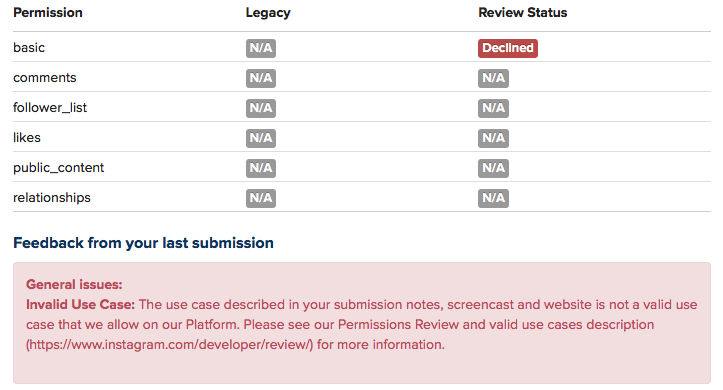
Now, we can lament about lost programming time (it wasn’t much fortunately) and research projects that will run into trouble, but the real problem, I think, connects to the question of transparency as I framed it above. Sure, a little script would never have solved the problem how to understand platform dynamics, but it was a little step on the ladder. There are certainly other means to do research and even data-driven research will be possible through scraping. But I wonder how far ethnographic studies, for example, are able to address questions concerning macro effects. And I wonder how sustainable and scalable scraping is. Sure, we can play the cat and mouse game with automatic bot detection and evolving interfaces, but is this going to produce the large window on these platforms we need to really understand them in terms of their effects on publicness? Maybe I’ll make some changes to VTE and submit it again, even though I have basically no feedback to go on. Maybe it will pass. But the larger problem will remain.
What is needed, I think, is something different. Yes, data retrieval, even by academic researchers, raises concerns about privacy. But privacy is not the only legitimate political aspiration, here. What, indeed, about publicness? What about the need to know about stuff in order to make democratic decisions? How to even begin to think about regulation if real outcomes are getting more and more difficult to assess? This is why I want to iterate an argument that I already tried to make during the EC’s public consultation: we need a legal framework to guarantee at least some access to API data, at least for some people. It is certainly nice that companies start research collaborations, but these fit of course into a sanitized view on their services. We therefore need, I think, something that is able to express the public’s legitimate interest to know “what’s going on” and access to API data is, in my view, a more promising avenue than the forms of purely technical or operational transparency that are often discussed. Fair use principles, for example concerning copyright, exist in academia because there is a belief that research that is not beholden to corporate interest performs a function in public life that is worth protecting. Can we imagine something similar with API data? A legally protected means to do research into these platforms? To find a compromise between privacy and publicness, we would have to find a way to distinguish between “disinterested” research and other applications. But technically, everything is in place. The APIs are there, even if they are closing down after their utility for growing the ecosystem has expired and selling data to analytics companies is becoming a revenue stream. The tools are in place and the researchers are starting to understand how to use them in useful ways. Compared to the daunting legal battles around antitrust measures, it’s almost banal to make this a reality.
Even if this idea proves to be a pipe dream, I think that we have to widen the debate around the values to take into account when criticizing the role of platforms in public life. Privacy is important, but public understanding of outcomes is as well.
When it comes to social media, YouTube is maybe the most understudied platform considering it’s enormous popularity in the context of popular culture, politics, and commerce. As part of a long term project on APIs from a software/platform studies perspective, but also in relation to the technical fieldwork required for data-driven empirical work, I have been testing the interfaces of quite a number of services now. To make this investigation productive beyond conceptual reflection, I’ve been building digital methods research tools for every system I look at. Nothing beats getting your hands dirty.
Since Google closed its search API some years ago, I haven’t really had a look at their services, but when a student of mine, Anouk Brouwer, started a thesis project on the booktube community on YouTube, I was not only fascinated by the booktube phenomenon and similar practices, but eager to revisit some older scripts and the new Data API v3 to see what kind of analyses would be possible. Google now has a centralized credential system for most of their APIs and a new quota framework where different calls cost different amounts of points. This sounds complicated, but since the quotas are extremely high (50M points/day, 3K calls/second), this is basically API dream land. After banging my head against Facebook’s technical and legal bureaucracy, it’s been extremely rewarding to work with a system that can take much, much more than I’m able to throw at it.
The outcome of this is a new set of scripts, called YouTube Data Tools (YTDT). You can try them out directly online or get the source code. For the moment, there are five modules that focus on different sections of the platform. The different features are explained in the tool interface, but I wanted to share a small experiment, made with the Channel Network module. This module starts from a set of channel ids and then crawls into the network constituted by YouTube’s featured channel feature (channels can “feature” other channels, basically just linking to them from their “channels” tab). The following image, made with gephi, shows a network of nearly 40k channels retrieved by starting with a single seed (the Vsauce channel) and crawling 7 steps into the network (click on the image for a much larger version, a PDF file is also available, as is the data):

Since a number of channels do not make their view count available, node size and color encode the number of subscribers. I’ve deleted the labels for channels with fewer than 100k subscribers for better readability and used OpenOrd for spatialization. The network is strongly clustered, in particular around practices (gaming, fashion & makeup, etc.), languages, and corporate affiliations (e.g. the Vevo and Disney empires). I wasn’t entirely aware just how many people like to watch other people play games. YouTube is obviously much bigger than this, but the map should show a sizeable portion of the upper echelons of the YouTube hierarchy.
YTDT allows for many other kinds of analysis, and I am planning to introduce them in an overview video in the hopefully not too far future. This is still an early version, but maybe already useful to some people out there.
EDIT (13/05/2015): I made an introductory video:
It’s just a quick overview, but hopefully useful as a starting point.
EDIT (23/01/2015): Changed some text to make clear that you can still run Netvizz by grabbing the source code, registering a new app, and running it in developer mode.
EDIT (25/01/2015): I have written a small install guide for the source code on github. I’m unfortunately unable to help with individual problems, if you’re unfamiliar with server administration, your department’s tech support team should be able to help.
EDIT (28/01/2015): Since Facebook has changed the way apps are created, you can apparently no longer run just scripts requiring extended permissions in newly created apps, even in developer mode (making my source code useless for you). I have therefore whipped up a version of Netvizz that can only do pages and groups without requiring extended permissions. Since this does not have to go through review, you can use the app directly here.
EDIT (29/01/2015): Facebook’s policy review has accepted the new version of Netvizz (with personal network functions removed) and the app is again accessible here. API v1.0 is still going to be retired in April and this may pose problems, but this is something for another day.
EDIT (02/05/2015): API v1.0 has now been retired, but a new version of Netvizz (v1.2) has survived the changes and should continue functioning in the foreseeable future. Personal and group friendship networks are gone for good.
Original Post:
Today Netvizz, an app that allows researchers to download data from the Facebook platform, was suspended by the company and I received a mail explaining why:
Your app is violating the following Platform Policies:
Platform Policy Section 1: Build a quality product.
Platform Policy 1.1: Build an app that is stable and easily navigable.Platform Policy 3.3: Only use friend data (including friends list) in the person’s experience in your app.
To clarify, your app should be stable and easy to use and shouldn’t stall escessively. Additionally, you should not allow friend data export, even if that data is anonymized. You can access the full list of our Platform Policies here: https://developers.facebook.com/policy/.
Since Facebook has recently been very preoccupied with app privacy – for very good reasons actually – this does not come as a surprise. I have been anticipating API changes and the retirement of version 1.0 that comes with some very sensible changes in how data is delivered to platform apps for a while. Apps are clearly one of the biggest problems when it comes to Facebook’s privacy puzzle and most changes make a lot of sense. As Bernie Hogan wrote here, friendship connections are one of the casualties, as they will no longer be available to apps at all (v2.2 no longer makes them available). I was hoping to stall a little by moving to API v2.0, which still runs until April 2016, but this seems no longer viable after this morning’s news. As much as I agree with the general changes Facebook is making, I think it is a real shame that the analytical possibilities apps like Netvizz afford will no longer be available to researchers.
Over its roughly five year life span, what started as an inquiry into Facebook’s API, ultimately had over 60K unique users and analyzing their friendship network has been the start into graph analysis for many people. GetNet, a modified version of Netvizz, was used by Lada Adamic in her highly successful Coursera MOOC, allowing students to look at a network they are intimately familiar with, making network visualization much more tangible. GetNet actually still works, but will probably break in April 2015, if not shut down earlier.
For me personally, Netvizz has been a ambivalent project. On the one side, I enjoyed the tinkering with the API, but on the other, maintaining a complex tool in my spare time has often been a challenge. As anybody who offers software online for free will tell you, the mass of not always friendly emails can be daunting. I’m also not a computer scientist and I work in a humanities department, where technical work does not really count in performance reviews.
But the real problem with the current situation has little to do with me and much more with the many courses and research projects that have been relying on Netvizz. They are left out in the cold. So here are some elements that will hopefully help them deal with the situation:
- Despite my hesitation to make software public that can be used very easily to download large amounts of non-anonymized data, there is so much code already in the wild that another set of scripts is not going to make much of a difference. I’m therefore making Netvizz’ source code publicly available.
This should allow research projects relying on Netvizz to take the source code, register their own app at developers.facebook.com and run it in developer mode (just to make this clear, since I am the developer, I can actually still run the app, but it is no longer publicly available), which should work until April 30, 2015, the day v1.0 of the API retires.I apologize for the crappy code quality, this is one of those projects that grow and grow and never get a real redesign. - I will try to enter into further communication with Facebook to see what can be done, but I don’t expect much from that.
- If that does not work, I will submit a version of Netvizz version for review that excludes personal network features and focuses on pages and groups. It’s still going to “stall excessively”, though, since it gets a lot of data.
I have no idea how long any of this make take. In the meantime, check out this list for alternatives, most of which hopefully still work. But make no mistake: this may well be the beginning of the end for external Facebook research with digital methods.
It’s a hot day in Amsterdam and writing is going slow. After reading this post on reddit, I ditched the writing for some playtime. In the post, /u/duckvimes_ charts the moderator overlaps between between /r/holocaust and a bunch of racist subreddits. The case is super interesting and the visualization very well done, but I thought that one could generalize the approach and create a map of reddit by looking at how subreddits’ moderators overlap. So I quickly wrote three scripts:
- A script that gets the 10.000 most polular subreddits according to the GET_subreddits_popular API call.
- A script that gets the moderator list for each of these subreddits
- A script that generates a bipartite graph file containing all subreddits and moderators and connections between them
You can download a GDF file containing the 3000 most subscribed to subreddits file here.

To generate the visualization above (click for larger image, here’s a PDF), I used gephi‘s MultiMode plugin to transform the bipartite graph (which contains both subreddits and users) into a monopartite graph that connects two subreddits if they share a moderator; the more mods they share, the higher the link weight. In the visualization below, node size indicates number of subscribers and color the created date (blue => yellow => red indicates older to younger). Enjoy. (And now back to writing.)
Facebook is a nasty thing to study. It is much more complicated – in terms of interface, architecture, features, etc. – than Twitter for example. It has a lot of users and different types of interaction spaces. It is rather easy to extract a lot of data from it, particularly for companies creating apps and focusing on individual users and their network neighborhoods – but it is really difficult to get any kind of macro view. Pages and groups are the main “holes” through which researchers that don’t have an agreement with Facebook can get an idea about interaction patterns and the brand of publicness the service provides. Some time ago, I added page analysis features to netvizz and we’ve been doing some interesting things with that feature. A couple of months ago, I learned from Erik Hekman that the SQL code I used to extract friendship connections for ego networks and groups could actually be applied to any list of users. I am not yet fully sure how privacy settings affect this, but for a while now, the developer version of netvizz has been able to extract friendship connections between users active on a page. This feature will not make it into the public version (or maybe limited to a very low number of users), because the number of API calls necessary to get the connections grows with no of users^2 / 2, quickly leading to impossible waiting time. It’s still an interesting approach that merits a quick post.
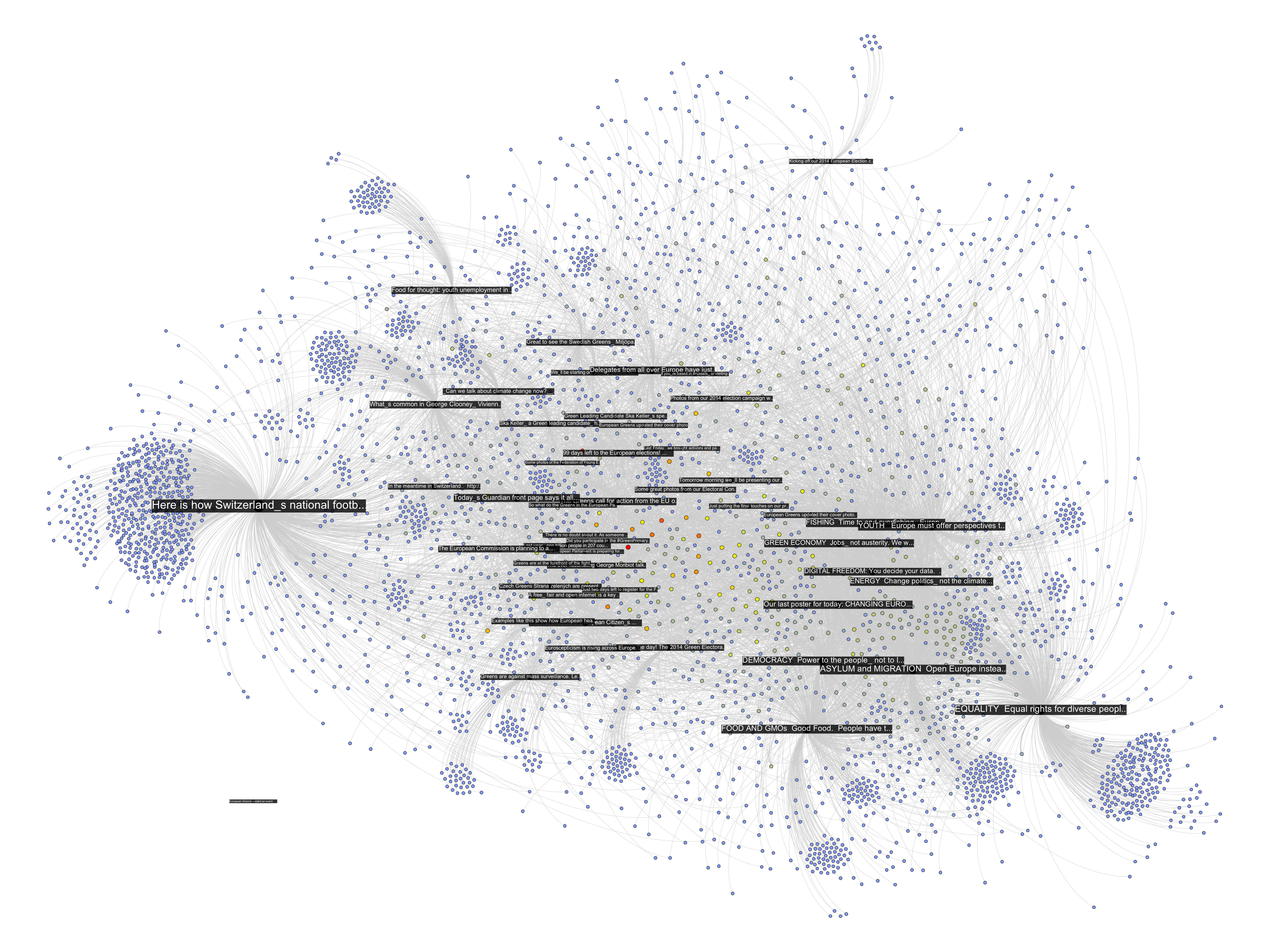
The following network diagram (click for larger image) shows a bipartite graph containing the last 50 posts from the Facebook page of the European Green Party and the 3768 users liking or commenting posts. Posts are in black and users range from blue to red depending on the number of times they engaged with content on the page.
There are already quite a number of things one could say about the page using the standard netvizz data. But let’s have a look what friendship connections can add. The next diagram is exactly the same as the last one, but adds friendship connections between users in green (click for larger image).

There seems to be one pretty big group at the top that are a lot friends with each other and those are probably activists. The contents in that area seem to have to do with the official start of the campaign for the upcoming European Parliament elections. At the bottom slightly to the right is another dense cluster of users that one could qualify as issue audience – users that engage with topics such as GMOs or surveillance. The other two groups on the left are harder to qualify. I have to add an important point though. To facilitate comparability, I spatialized the nodes with friendship relations present. To generate the first diagram, I then simply removed those edges but left the layout intact. In the following image, though, I reapplied Mathieu Jacomy’s ForceAtlas 2 algorithm.

Now, only the edges encoding interaction or “engagement” between users and posts are taken account and the friendships no longer are. The way the posts are related to each other changes surprisingly little. Only the “asylum and migration” (a political initiative) post is placed a bit more to the top left, probably pulled by the top cluster of dense friendship connections. What that means, I guess, is that the engagement with content correlates with “social structure”, or whatever friendships on Facebook could meaningfully express. If the four tightly knit pockets were more heterogeneous in the way they engage with content, removing the friendship connections and rerunning the algorithm would have deformed the post distribution much more. If we consider that European parties have a quite fragmented party structure, this is not surprising. To probe a bit, I colored the interface language of the nodes in the next diagram (again back to spatialization with friendship connections taken into account, although they’re not shown in the image):

Certainly, there is some language clustering in the top group. And the one at the bottom, the one I called “issue audience” above, that’s the Germans. But still, this is a pretty diverse audience, very cool. There are clearly a lot of activists on that page, people traveling and exchanging, that’s why they are so connected. But the picture changes a little if we take the content out of the picture and look at friendship structure only:

First, we notice that most of the users are not connected to the big component in the middle; there’s a scattered audience next to the activists. Second, we see quite a large number of components with two or three nodes. These are very probably artifacts of Facebook’s architecture. If I like a post on a page, it has a certain chance of appearing in my friends’ newsfeed, where it can the be liked or commented on without every going to the page directly. I’ve seen these smaller components even more on other pages and this seems to be the most probable explanation. Third, despite stronger clustering without the content holding things together, there is still a very large connected component that comprises a bit over a third of the active users. Fourth, the most active users (the heat scale still shows number of engagements) are not necessarily the most connected ones.
To close off, two last diagrams, first with color encoding interface language:

This confirms the clustering by language/county, but also shows that there indeed is quite some mixing. Looking for the connectors between the countries clusters is relatively easy using betweenness centrality (color, again using a heat scale):
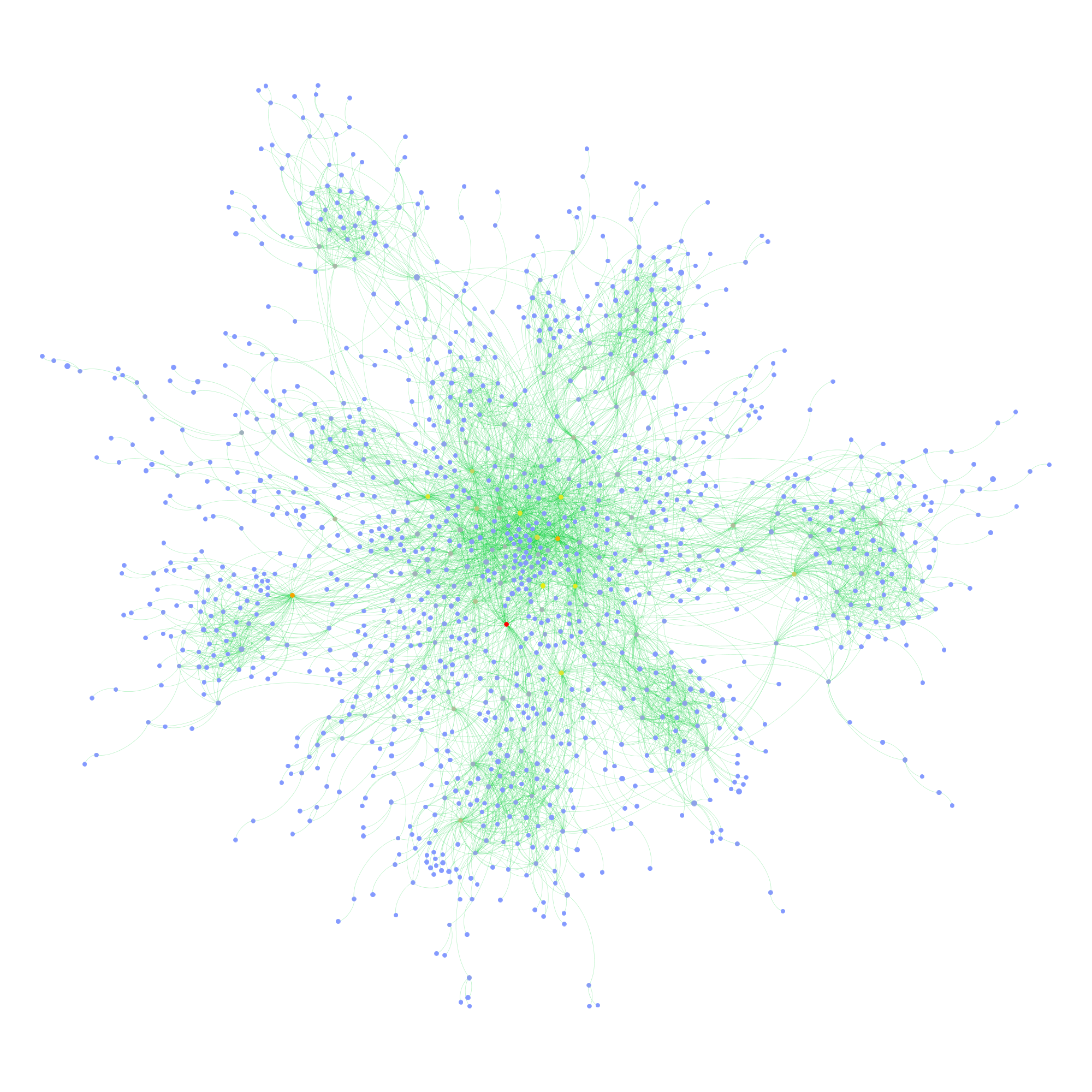
While netvizz provides node data in anonymized form, all of this stuff is available through the Facebook API with real names attached. I hope that users are aware at this point that pages are highly public spaces that can easily be profiled in quite some detail by anybody with a little programming skill. If I wanted to disrupt this organization, I’d start with the red dot in the last network diagram. Is it chilly in here?
This could be developed much further as well. But I am not sure yet how much weight one can put on the friendship data because of the question how much is missing because of privacy settings (which you may want to learn more about). The fact that obviously a lot of connections are publicly visible and relatively easy to harvest in small doses would merit much more discussion on its own. I am also pretty sure that big pages over large timespans are completely out of the question for reasons of the dreaded combinatorial explosion kicking in. Remember the rice corns on the chess board? And even if one would succeed in hammering the API, the data would be very difficult to analyze and to untangle. Lots of custom math needed; or a lot of patience; or both.
This could go nowhere but the results warrant a followup.
This should probably go into a funstuff section somewhere, but I used some moments of free time today to upload a script I have written some time ago to github. It’s a very simple piece of code that grabs images tagged with a specified word and, by looking at which tags appear together, creates a co-tag graph file in .gdf format. You can get it from here or run it here. To test how it scales – and to finally know what teens (apparently tumblr’s main audience) dream of – I tried it with 500 sets of 20 images for the tag “dream”. This leads to some 7K distinct tags and after some filtering, that’s what comes out (click image for lager view):

Node size is occurrence count and color (blue => yellow => red) is betweenness centrality. Apparently, love is still a thing out there. Nice.
This may become an actual tool further down the road, but maybe it’s already useful to somebody as is.
EDIT: Try it out here: https://lab.digitalmethods.net/~brieder/tumblr/tagnet/
I have recently added a new feature to the netvizz application: page like networks. This is basically a simple “like crawler” for like relationships between pages on Facebook. It starts with a seed page, gets all the pages liked by it, then gets their likes and so forth. Well, because the feature is new, I’m limiting crawl depth to two, in order to see how many resources are needed. In this post, I’ll quickly go over an example to show what one can do with this, but also to discuss a number of questions related to network analysis and visualization as such.
Network analysis and visualization (NAV) has made quite an entry into social science and humanities research circles over the last couple of years and the hype has contributed to the dominance of the network concept in new media studies and beyond. This dominance has been rightfully criticized and the pretty pictures of points and lines have received their fair share of disparaging commentary. While there are many questions and problems related to NAV, a lot of the criticism I have read or heard is superficial and lacks both understanding of the analytical gestures put forward by NAV and literacy of the diagrams one encounters so frequently now. Concerning the latter point, the main error is to consider the output of network visualization first and foremost as an image; with Barthes, I would suggest to look at them as denotative rather than connotative, as language or code more than image. This means that successful use of a network diagram requires reading skills and knowledge of the production apparatus. In their absence, well, every diagram looks likely the same.
To tease out something truly interesting from a graph – the mathematical representation of a network – a lot is needed and many, many mistakes can be made. But much like statistics, NAV is a powerful tool if handled with care. Let’s consider the following gephi diagram (data available as a .gdf file here, click for larger image):

This is the visualization of a network of 370 pages on Facebook with every node a page and every link an act of “liking”. Keeping with the topic of a recent data-sprint we had with our New Media and Digital Culture MA students about Anti-Islamism, I took the “Stop Islamization of the World” page as starting point and crawled two steps into the network. The result is a quite striking web of pages that clusters – at least according to gephi’s modularity algorithm – quite neatly into four groups. In purple, we find a group of pages (122 nodes) that are explicitly focused on countering Islam; in green – and very well connected to the first group – there is a “defence league” cluster (79 nodes), basically a network of strongly islamophobic street protest groups; in red, we see a group of sites associated with Israel (145 nodes); finally, in turquoise, a much smaller and eccentric group (24 nodes) that could be called “tattoo cluster” dedicated to getting ink done. Because pages do not necessarily reciprocate liking, this is a directed graph, i.e. every link has a source and a target. The curve of the links encodes this direction: a link that bends clockwise in relation to a node is an outgoing link, counter-clockwise is incoming. In this diagram – and in all that follow – node size is a simple count of inlinks.
How does one read something like this? What does it mean? At first glance, a like crawl starting with an islamophobic page results in a large number of pages related to Israel. But what kind of entanglement is this? I think that this question cannot be answered intelligently simply by looking at a single projection of the graph as a diagram. Besides a healthy distrust of the data (why this seed? why not others? how does crawl depth affect the result? are there privacy settings in place? etc.), any non-trivial network needs to be investigated from different angles to even begin understanding its structure. As I have tried to show elsewhere, different layout algorithms flatten the n-dimensional adjacency matrix into two-dimensional diagrams in quite different ways, each bringing particular aspects of the graph structure to the foreground. But there is much more to take into account. In the above diagram, we can easily spot nodes that are bigger than others, meaning that they receive more likes. (side node: it really helps to download all images and flip through them with a decent image viewer – all networks have exactly the same size and layout, only the color changes) Can we conclude that “United with Israel” and the “Isreali Defense Forces” (both 55 inlinks) are the most important actors in this network? And what would “important” then mean? Let’s start with Google’s definition and apply PageRank to our network using a heat scale (blue => yellow => red, click for larger image):

This is quite striking. We start with an Anti-Islam page and end up with the Isreali Defense Forces as the node with the most authority. Now, as I have tried to show recently, PageRank is a complicated beast and far from a simple measure of popularity. Rather, one can think about it as a complex flow of status along links that is highly dependent on topological positioning. Who links is at least as important as the number of links – and because status is passed along, the question of who does not link is crucial. Non-random networks are generally strongly hierarchical and PageRank exploits these asymmetries to the fullest. Let’s investigate further by looking at our network in aggregate form:
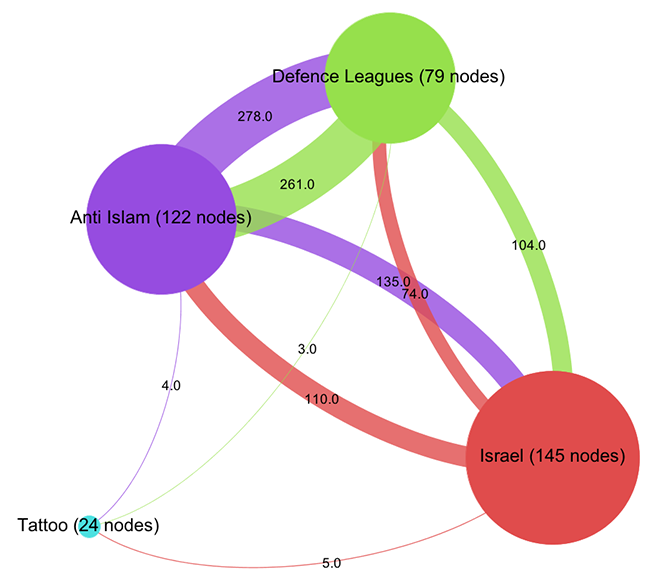
Already, a certain disequilibrium becomes visible here: while the Anti-Islam and Defence League clusters are liking back and forth in roughly equal manner, both like pages in the Israel cluster a lot more than they are liked back. But the disequilibrium is certainly not strong enough to simply diagnose a case of non-reciprocated affection. This would have been too easy. To further qualify the graph structure, we need to be able to say more about who links and who does not link. Let’s leave the force-based layout for a moment and look at the network in yet another way (click for larger image):
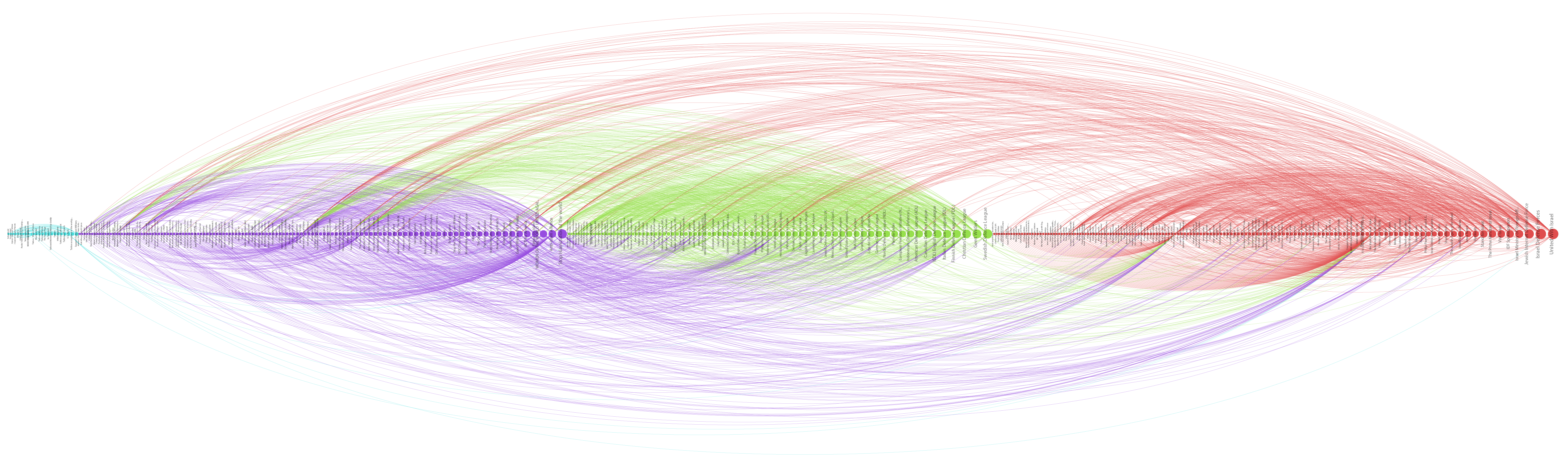
Here, I have not only arranged nodes on a line, grouped by clusters and ordered by inlink count, but I have also colored links according to their target. This means that we can very well see (on the hi-res image at least) into which cluster individual nodes are linking and even get an aggregate picture of relationships between groups. A nuanced account begins to emerge by looking at the linking practices of the top 10 pages: in the purple anti-islam cluster, page 1,2,4,6,7 and 9 link to the red israel cluster; in the green defence league cluster, 5 and 8 do so as well. But in the Israel cluster, only page 8 and 10 link to the former two. We can thus further qualify the disequilibrium mentioned above: in additional to a mere imbalance in numbers, we can observe a disequilibrium in status; high status nodes from the extremist clusters link to the Israel group, but the latter’s top pages do not like back. This explains why PageRank concentrates on the IDF page: it receives a lot of status, but does not feed it back into the network. If Facebook can stand in for the mapping of complex socio-political relationships – which it probably cannot – we could argue that the “official” Israel is clearly reluctant to associate with islamophobic extremism. But then, why is there a network in the first place? What holds it together?
Let’s start by looking at the most prolific likers in our network. The next diagram (click for larger image) shows the nodes with the highest outlink count:

Here, we see the most active likers, but we also notice that the page with the most likes (“We Stand With Israel – Siotw”) is quite small, which means that other pages do not like it very much. A better way to look at network cohesion in terms of structural positioning is thus to use a measure called betweenness centrality (click for larger image):
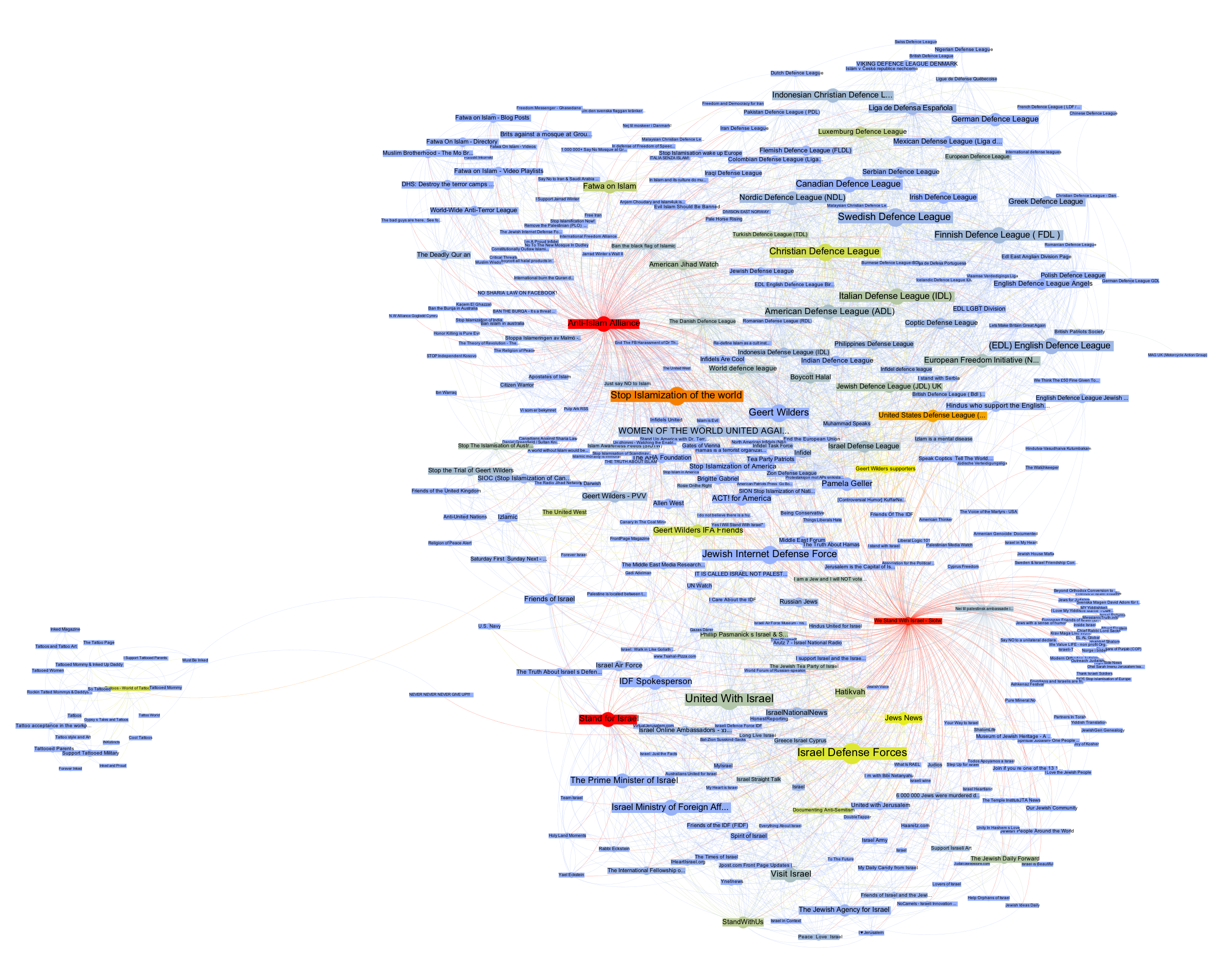
Betweenness centrality is often interpreted as close to the notion of bridging capital, i.e. the capacity of an actor to connect different groups. Because betweenness centrality is calculated by looking at the placement of nodes on the shortest paths in a network, it is not simply the heaviest linkers that are being put to the front here. However, some of the heavy linkers remain indeed important and if we take away “We Stand With Israel – Siotw”, a large number of the likes from the Israel cluster to the other two evaporate. The heavy linkers are indeed important for holding the network together.
But we also see the rise of a very interesting node, “Stand for Israel”. While it receives likes from apparently neutral pages such as “Visit Israel”, it is the top Israel cluster page to link into the Defence League cluster, to the “United States Defense League” page to be precise. While “Stand for Israel” announces on their page that “Violent, obscene, profane, hateful, or racist content will be deleted and offenders blocked from the page without notice” (and this indeed seems to be the case), they do like a page that is full of exactly that. That’s playing the role of a broker. In a sense, we can look at like patterns to produce actor descriptions.
What emerges through this still very superficial exploration – I made a point of not looking at the pages themselves as much as possible to focus on a pure NAV approach (which would be quite absurd in an actual research project) – is a set of rather complex relationships between pages that needs to be examined in different ways to even begin to make sense of. The diagrams, here, are not means to communicate findings, but artifacts that become truly salient only by combining, juxtaposing, and narrating them in combination. They are somehow less explanatory than in need of explanation. Let’s look at a final diagram to add yet another perspective (click for larger image):

Here, the heat scale encodes “like_count”, i.e. the number of times a page has been liked by Facebook users, not other pages. Suddenly, the picture flips completely. Albert Einstein and Tattoos lead the pack, but in the middle of the network, two nodes stand out, giving us further clues about how our clusters connect to larger political elements: “Tea Party Patriots” and “Being Conservative”.
Again, I would be very hesitant to make any claims based on the NAV of a set of Facebook pages and how they like each other, in particular in a context as sensitive as this one. Nonetheless, I hope that it becomes clear from this quick example that NAV provides means to investigate a network through multilayered and nuanced explorations of structural patterns that are simply not visible to the naked eye. And this is only a small subset of the many analytical gestures afforded by NAV. In my view, there certainly is an inflation of network diagrams and there are many limits to analyzing phenomena through formalization as points and lines. But much like the case of statistics, the often problematic use of formal techniques should not mean that we have to throw out the baby with the bathwater.
While I am still somewhat of a beginner in NAV, if there is one thing I have learned, it is that we should see network diagrams as specific projections or interpretations of the graph, as slices that interrogate data in particular ways, and that multiple such perspectives are needed to actually produce a picture.
One of the reasons I started to develop the netvizz application, was to get better insights into how Facebook envisions exchange of data and functionality with third party developers. From the beginning, I was quite amazed how much data a third-party app could actually get from the platform – not only about the users that actually install an app, but also about their friends and the groups they are members of. I hope to provide a systematic account of what I’ve learned at some point in the future. But today, I want to discuss a particular element in some more detail, the “read_stream” permission.
To introduce the matter, a couple of points concerning the Facebook APIs as such: every application written by a third-party developer requires a logged in user and this user defines the “scope” of data access the running instance of the application can get – remember that applications are generally used by many users, so the data gleaned from individual scopes can be combined. Applications have to explicitly ask for permission to access certain items and Facebook provides extensive documentation on the permission system, the profile properties, and a set of extended permissions. Users are asked to grant these permissions when they first start an app. This is the permission dialogue for netvizz:

Netvizz currently asks for the following permissions: user_status, user_groups, friends_likes, user_likes, and read_stream. When installing, you cannot refuse individual elements that are not considered “extended permissions”, only decide to not use the app at all. The user_status is actually superfluous and will be removed in the next iteration. The user_groups permission is needed to access group data and both _likes permissions are used for netvizz’ like network functionality.
Now, working on a couple of new features over the last months, I started to get more interested in posts because they have probably become the closest thing to a “carrier of publicness” on the Facebook platform. I was quite amazed how easy it was to extract large numbers of users and (some) of their data from pages – both likes and comments users make on post on or by pages are in principle up for grabs. When doing some housekeeping recently, I noticed that some of the “engagement” metrics netvizz had provided for users’ friends in earlier versions were either broken or outdated and I decided to simply count the number of likes and posts friends make to replace the older metrics. I expected to only be able to read likes – through the friends_likes permission – and public posts. This was indeed true: in the beginning, all I got were public posts. Because I could get much more data through the Graph API Explorer, a developer sandbox that asks for all permissions by default (which can be changed, a great way to explore the permission structure), I discovered the read_stream permission.
The read_stream permission is presented by Facebook in the following way: “Provides access to all the posts in the user’s News Feed and enables your application to perform searches against the user’s News Feed.” It is a so-called “extended permission”, the developer doc noting that “Extended Permissions give access to more sensitive info and the ability to publish and delete data”. And, indeed, when asking for read_stream in netvizz, I suddenly got access to many more posts made by my friends, mostly going from “none” to “a lot”. From what I could gather after some random testing was that I basically got access to all of the activities from my friends that would show up in my newsfeed, without the “top stories” filter. Because many things have the status of “post”, I could get a rather detailed (and timestamped) account of what my friends are doing on the platform. You can check out your own “posts” feed by following this link into the Graph API Explorer. Because comments and likes by users who you are not friends with on posts by somebody you are friends with also show up in your news feed, the read_stream permission allows to capture their activity as well. Facebook seems to be aware of this: because read_stream is an extended permission it gets its own permission dialogue and can actually be skipped:
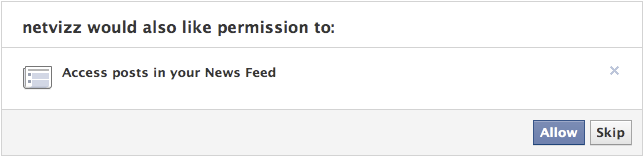
This is a good thing, but the wording seems a bit sparse: “Posts in your newsfeed” actually translates to “a minute account of your friends’ activities”. Granted, buried in the privacy settings is an option that allows us to modify more generally what information we share with the apps other people use, and these are the default settings:
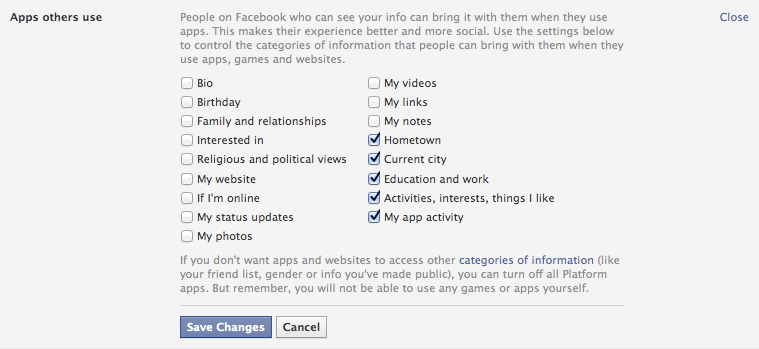
It’s the “Activities, interests, things I like” option that allows the read_stream permission to work its magic. The people I am friends with on the platform are generally a rather privacy conscious bunch, but I could get the posts from most of them.
This is not a privacy scandal of any sort, measures are in place, but one can still make a couple of points:
- Apps as means for data capture are clearly not discussed enough. For serious data collection, however, going through the API is clearly the way to go and we need to pay more attention to this.
- Again and again: defaults matter. As seen above, the data available to apps used by friends is quite extensive with default settings.
- Again and again: language matters. The read_stream permission dialogue is certainly not explicit enough. Also: why is “app privacy” not in the privacy tab here?
- When we log into a third party site with our Facebook login, we are basically running an app. May be worth pondering what data we are shipping over.
Exploring APIs as important actors in the privacy debate and beyond is crucial. It’s often complicated work, though, and I hope that the developer community can help with that work a bit. It would be highly useful, I think.
Netvizz, a Facebook research app for extracting data from the dominant social networking service, has gained a new feature: page exploration. While the app has been able to get ego-networks and group networks from the start, this is the first time that data for pages can be extracted as well. The Social Network Importer for NodeXL already allows for extracting both co-engagement (users that comment or like the same post are connected) and bipartite networks (both posts and users are in the graph) from Facebook pages but requires you to use NodeXL and Microsoft Office on Windows.
The first implementation of page exploration on netvizz only provides bipartite network files only and yields less data on users, but adds information on the page posts themselves and outputs them both as a graph file and a simple tab-separated text file. For the moment, the app captures a user specified number of posts from the page and loads up to 1000 comments and 1000 likes. It also specifies the type of post in both of the files it generates. This is the (edgeless) network created from the last 100 posts of the New York Times Facebook page:

Users are gray, videos are blue, links are red, photos are yellow and status updates are green. Size is engagement. Because distance from the center indicates stronger engagement from non regular users, one can easily see that both photos and status updates are engaging a different audience than the links and videos.
Visualizing the data from the tsv file, we can explore these kind of relations further. Here, I used Mondrian‘s capacity to show highlights in one chart on all other open charts:
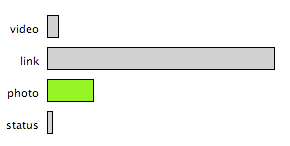

By selecting photos in the barchart, the scatterplot (x: likes, y: comments) shows that photos not only produce much higher engagement scores (the engagement value in both the tsv and gdf files combines numbers of likes, comments, shares, and likes for comments into a single metric) – the median for links is 453, but 1724 for photos – but that there is also a tendency for photos to provoke a comment/like ratio that trends toward the former. This is data from about 10 days of activity, so not suited to make any larger claims – interesting nonetheless.
As already mentioned here, the next step is to produce network files for multiple pages.